


Faculty & Research

Faculty & Research
Highest-Paying College Majors: How to Choose a Degree

By Jiang Yuan, Associate Professor of Management, CEIBS
The highest-paying college majors tend to cluster in engineering, computing and finance, but the best major for any individual student is rarely the one with the highest average salary alone. This article looks at what the data actually says about earnings by field, and at the factors, beyond pay, that should shape how students choose.
Major selection is only the first step toward wider career development, and as such, the career prospects of a major should be viewed from a dynamic development perspective. Moreover, the alignment of values between organisations and individuals, and the compatibility between individual abilities and job demands, are both highly related to one's career success.
What Are the Highest-Paying College Majors?
Salary is not the only measure of a major's career prospects, but it is an important consideration for many students. So which majors currently offer the strongest earning potential? The answer varies across countries, but recent graduate data from China, Europe, and the United States shows that some fields, particularly engineering and computing-related disciplines, tend to lead on earnings.
In China
China’s latest graduate employment data shows a strong advantage for engineering majors. According to the 2026 Chinese College Graduates Employment Report (also known as the Employment Blue Book) by the MyCOS Research Institute, graduates earned an average of RMB 6,435 per month, well above urban residents' average monthly disposable income in the same period (RMB 4,709). Higher vocational graduates averaged RMB 4,882. After adjusting for inflation, undergraduate starting salaries rose 7.7% compared with the Class of 2021.
MyCOS also named its 2026 undergraduate “Green Card Majors,” which show consistently high employment quality and growing industry demand, as follows:
- Electrical Engineering and Automation
- Microelectronics Science and Engineering
- Automation
- Energy and Power Engineering
- Automobile Engineering
- New Energy Science and Engineering
All six are engineering disciplines, and Automation joined the list for the first time this year. Graduates from these majors mainly enter energy and power, integrated circuits, intelligent manufacturing, and new energy vehicles.
These results reinforce a point discussed later in this piece: a major’s value cannot be assessed through salary alone. MyCOS’ Green Card and Red Card classifications consider a wider combination of employment outcomes and labour-market demand.
In Europe
The European picture is more difficult to reduce to a single salary ranking because earnings vary substantially between countries. An EUROGRADUATE comparative study, which surveyed graduates across participating European countries, provides a more comparable measure by converting earnings into purchasing-power-adjusted euros.
Among graduates in countries with comparable earnings data, ICT and engineering had the highest median gross hourly earnings at €15 in purchasing-power-adjusted terms. Business and law, natural sciences and mathematics, and health each recorded €13, followed by social sciences and journalism at €12. Arts and humanities and education and teacher training recorded €11.
The figures should not be read as the salary a graduate will receive in a particular European country. They are designed to make outcomes across different national economies more comparable. Even so, the broader finding is clear: EUROGRADUATE reports that graduates in ICT and engineering tend to have some of the strongest combinations of earnings and employment outcomes.
In the United States
A similar pattern appears in the United States. According to the National Association of Colleges and Employers' Winter 2026 Salary Survey, computer science is projected to be the highest-paid broad category for bachelor's graduates in the Class of 2026, with an average starting base salary of $81,535. Engineering follows closely at $81,198, while math and science are projected at $74,184 and business at $68,873.
Within engineering, petroleum engineering has the highest individual salary projection at $100,750. These are projected starting base salaries, rather than guaranteed earnings, and do not include bonuses, commissions, benefits, or overtime.
Across all three markets, the strongest starting salaries currently cluster around computing, engineering, and other technically specialised fields. That does not mean salary should determine a student's choice of major. Employment demand changes, individual career outcomes differ, and the relationship between a degree and a career develops well beyond the first job after graduation.
How Students Actually Choose: Interests, Family and Prospects
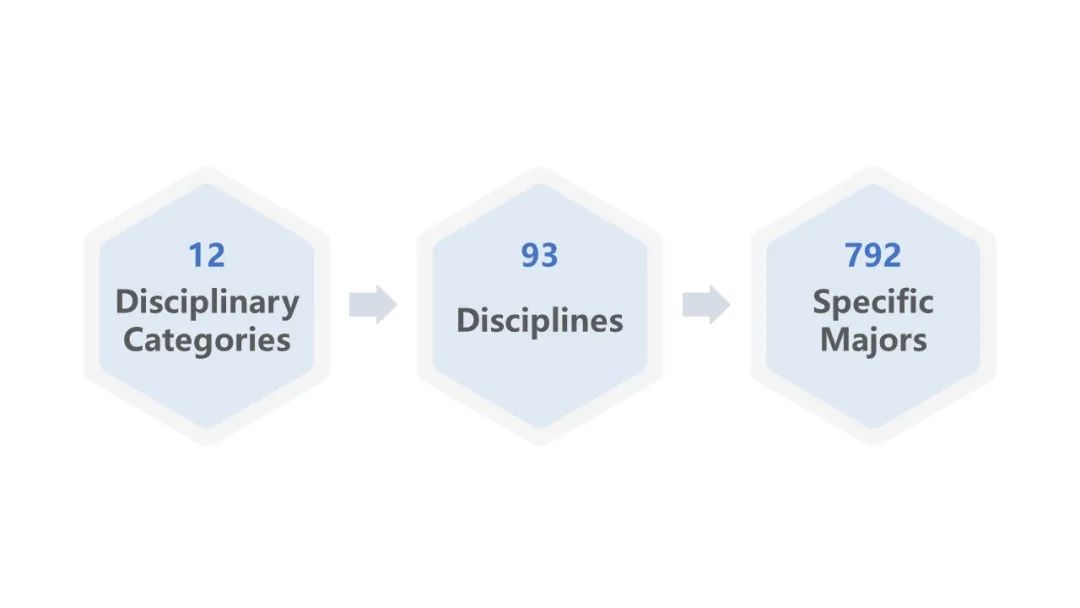
Let's look at the current selection of majors provided in Chinese universities. According to the Ministry of Education's 2026 undergraduate programme catalogue, China's undergraduate majors are divided into 13 disciplinary categories encompassing 92 major categories and a total of 883 specific majors.
How can students choose from 883 majors, while also taking a university's ranking and geographical location into consideration?
Statistical surveys show that of 11 chosen factors influencing students' choice of majors, the top four are personal interest, employment outlook, career development potential, and the individual's skills in a specific discipline. This highlights that students value both their innate interests and their employment prospects when choosing a major.
Parent and family preference also significantly shape students' major selection. In the traditional Chinese value system, the pursuit of higher education by the younger generation is not just the business of the individual but also a matter of great importance for the whole family, as one's professional choice is closely linked to the future of the family.
Academic research has found that family background may influence major selection differently among Chinese and American university students, partly because of differences in how and when students choose their field of study. In China, students generally choose a major as part of the university admissions process, and different majors may attract varying numbers of applicants due to disparities in their expected returns. Household income and other family circumstances may therefore influence the decision before enrolment. In the United States, students often have greater flexibility to declare or change their major after enrolling, although the process varies by university and programme. Financial aid, including student loans, may also affect the role that family resources play in these decisions.
The situation in Europe varies by country. In many European higher education systems, students apply directly to a specific subject or degree programme, which means the choice of field is often made before enrolment, as in China. However, the degree of flexibility students have to change programmes, specialise later, or move between fields differs considerably across national systems and institutions. Student funding arrangements also vary, so the influence of family circumstances on study choices cannot be described in the same way across Europe.
Another interesting phenomenon among Chinese college students is that while personal interest is important for both male and female students, the genders have different views towards future job opportunities. For example, female students tend to value the employment prospects associated with their major more than their male counterparts; they are also more likely to be influenced by the opinions of those around them. Psychological studies suggest that, under the influence of family, school, and social culture, female Chinese students tend to exhibit a stronger reliance on family and authority figures such as teachers, while men tend to display greater independence.
How to Identify Your Career Interests
For high school students that are in a stage of innocence and continuous physical and mental growth, identifying interests and selecting a suitable major is an essential step toward their future professional development. However, is their perceived interest truly their genuine passion? Are they sufficiently prepared psychologically for a future career related to their major?
According to Self-Directed Search (SDS), a career assessment and exploration tool based on a theory developed by American psychologist John Holland, both people and work environments can be classified according to six basic types: Realistic, Investigative, Artistic, Social, Enterprising, and Conventional. These categories are known collectively as RIASEC.
Based on vocational personality theory, Holland developed a career interest test inventory, which consists of four sections. The first section involves listing one’s ideal professions. The second section assesses the four aspects of activities, potentials, occupational preferences, and self-evaluation of one’s ability. The third part establishes a three-letter career code in descending order of scores obtained from the aforementioned four aspects. Finally, the fourth section is a career search table, which includes 1,335 occupations, each marked with a career code and the required educational level. Taken together, through systematic assessment and analysis, individuals can identify career types that suit their own characteristics.
Job Prospects and Career Growth by Major
Employment prospects are already an important part of how students choose a major. The question, then, is what those prospects actually look like after graduation. Which fields currently offer stronger employment outcomes, and how difficult is the wider graduate job market?
First, a growing number of university graduates has intensified competition for jobs. China's 2026 graduating class is expected to reach a record 12.7 million students, 480,000 more than in 2025. Employment conditions overall remain relatively stable, but younger jobseekers face greater pressure. According to official unemployment data, the surveyed urban unemployment rate for people aged 16–24, excluding students, reached 17.9% in July 2026, up from 14.9% in June as a new group of graduates entered the labour market.
Second, some majors currently have stronger employment prospects than others. The MyCOS 2026 Chinese College Student Employment Report identifies electrical engineering and automation, microelectronics science and engineering, automation, energy and power engineering, vehicle engineering, and new-energy science and engineering as this year's undergraduate "green-card" majors. These are fields with relatively strong employment quality and growing industry demand, and all six are engineering disciplines.
The 2026 "red-card" majors are painting, music performance, fine arts, cultural industries management, labour and social security, and urban and rural planning. MyCOS uses the red-card designation for majors with comparatively weak outcomes across measures such as employment, salary, and job satisfaction, alongside slow or declining market demand. Three of this year's six red-card majors are in the arts.
These results also show how quickly demand for particular skills can change. Network engineering, information security, and digital-media technology, for example, no longer appear on the 2026 green-card list, while automation has entered it for the first time. Students therefore need to consider current employment prospects without assuming that today's strongest-performing majors will remain in the same position throughout their careers.
Finally, stable employment remains highly attractive to many graduates. The national civil service examination, commonly known as the "Guokao," continues to draw intense interest. For the 2026 recruitment cycle, 3.718 million applicants passed the qualification review for around 38,100 planned positions, equivalent to approximately 98 qualified applicants for each place.
At the same time, graduates are looking beyond China's largest cities. The MyCOS 2026 employment report found that 63% of 2025 undergraduate graduates who entered employment were working in prefecture-level or lower-tier cities, compared with 58% of the Class of 2021. This reflects a broader movement of employment opportunities towards smaller cities as industries expand across different parts of the country.
Therefore, although China's overall employment situation remains relatively stable, fresh graduates still face considerable competition. Choosing a major therefore requires students to consider their interests alongside current labour-market demand and how employment opportunities may develop over time.
Why Choosing a Major Is Not a One-Off Decision
Selecting a major is just the beginning of any student’s journey towards a career. Once they enter university, exploring career options related to their major is even more critical for their life’s development.
Career exploration requires prospective students to view the career prospects of their major with a dynamic perspective. In reality, market demands change the types of graduates and skills employers need. Research from recruitment portal 51job found that employers were offering graduates more opportunities in product and technology R&D roles, rather than in previously dominant sales positions. More recent 51job research continues to point to strong demand for technology-related talent, particularly as AI-related roles expand across industries.
Undergraduate education is a process of continuously understanding your chosen major. During their studies, students may discover a mismatch between their personal interests and their chosen majors, a low or undesirable job outlook of their majors, or a skill gap that hinders their academic performance. In such circumstances, prompt changes are necessary. This reevaluation, based on academic learning and practical exposure (such as internships), is likely to be more effective.
The right match between individuals and positions is also important in the workplace. While the impact of different majors on a graduate’s employment is significant, it's not the sole factor. Past research has found that college students' job matching is not only related to their majors, but also to their genders and school levels. Moreover, the match between an individual's values and the organisation's values, as well as the match between a person's abilities and their job, are both significantly related to an employee's career growth.
Therefore, college students need to not only understand their abilities and interests when choosing a major, but also be aware of how their majors will fit into their future career in an organisation, and therefore improve themselves based on their ideal job positions in the future. Only when undergraduates spend time during their university years preparing themselves to step out of their ivory tower can they secure themselves a better chance to find a job that suits their preferences and showcases their professional talents.
Promoted from bold and renamed from "Selecting a major is not a one-off decision". Keep the argument in full, including the point that market demand has shifted graduate roles toward product and technology R&D, and the closing case that individual-position fit matters as much as the major. Update the 51job reference to its current edition.
Jiang Yuan is Associate Professor of Management at CEIBS. His research and teaching interests focus on career development, organisational behaviour, and how individual and organisational values shape workplace outcomes.
Frequently Asked Questions
What are the highest-paying college majors?
Engineering and computing consistently rank as the highest-paying fields at graduation, across China, Europe and the United States. In the US, petroleum, computer and software engineering lead starting salaries; in China, information security and microelectronics graduates earn the most; in Europe, ICT and engineering graduates report the highest median income.
Should I choose a major based on interest or salary?
Both matter, and the strongest choices tend to balance the two. Personal interest and skill fit help sustain motivation and performance over a career, while employment outlook and salary affect how easily that career gets off the ground. The right match between an individual's values, abilities and eventual job is what ultimately drives career success.
Do students in Europe, China and the United States choose differently?
Yes, to a degree. Chinese students typically select their major before enrolling and are more strongly influenced by family and household income, given a less developed student financial aid system. American and European students generally find it easier to change majors after enrolling, which tends to reduce the weight of family influence on the initial choice.
Can I change my major after enrolling?
It depends on the system. American and most European universities generally allow students to change or specialise their major partway through a degree. In China, this is comparatively harder, since students commit to a major before enrolment, though switching is possible in many cases through internal transfer processes.